Housing Case Study: Proof of Validation Framework
The Outcome
A housing complaint prepared through the JusticeTree workflow was:
- Accepted into county court record
- Accepted by HUD for formal review and investigation
This case demonstrates that structured evidence, clear timelines, and documented records can move successfully through multiple administrative and legal gates—from local court to federal housing authority.
Why This Matters for Research
This is not a coincidence. It is validation of a research hypothesis.
The hypothesis: If institutional decisions are structured around interrogative inquiry (Who, What, When, Where, Why, How) and validated before execution, they will withstand institutional scrutiny across multiple levels of review.
The evidence:
- Evidence organization: systematic, traceable, complete
- Timeline reconstruction: clear, documented, verifiable
- Document review: thorough, notarized, formal
- Institutional movement: court → federal agency → investigation
The case moved through multiple gates not because the allegation was sympathetic, but because the validation was sound.
The Strategic Model: Mission and Framework
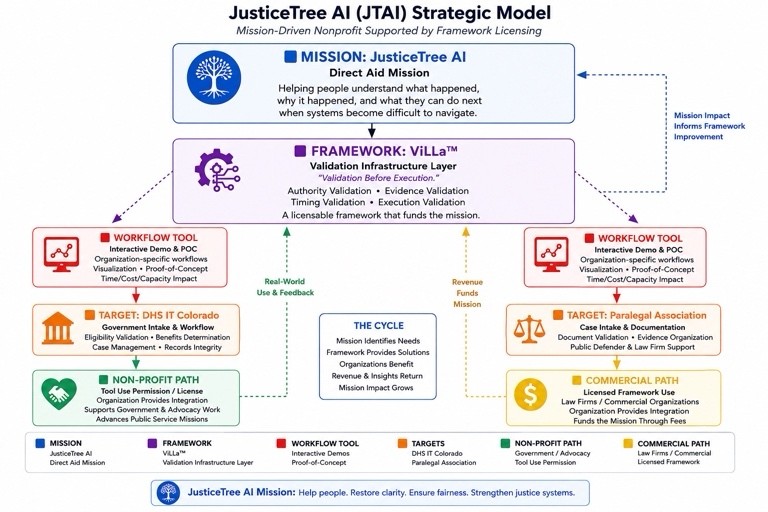
This case demonstrates a strategic separation: JusticeTree (the mission) is distinct from ViLLa™ (the validation framework). This diagram shows how the research operationalizes at institutional scale.
What Made Validation Work: The Infrastructure
Interrogative Structure
The case was prepared using a framework based on Geometric Inquiry Theory—the six interrogatives constitute a complete basis for institutional inquiry:
- Who validated the evidence? (Authority)
- What evidence exists and is it sufficient? (Evidence)
- When did events occur and were procedural timelines met? (Timing)
- How will the decision execute and what outcome does it produce? (Execution)
Each interrogative became a validation gate. The case could only move forward when each gate was resolved.
TraceStack Infrastructure
The case was managed using TraceStack—the non-commercial research infrastructure developed at Quantum Inquiry. TraceStack provides:
Documentary Accountability Substrate (DAS)
Maps relationships between evidence, authority, decision-maker, action, and outcome. Creates complete traceability. In this case, every piece of evidence carried its chain of responsibility and validation state.
Distributed Responsibility Tracking (DDRP)
Preserves who validated what, when, and on what basis. The case moved from JusticeTree to county court to HUD with complete preservation of who did what validation work at each stage. No validation was lost in handoffs.
Decision-State Architecture
The current validation state of the case was always resolvable. "Is evidence complete?" "Are timelines verified?" "Is the submission formally correct?" The system always knew.
Proof of Inaction
When questions arose about missing evidence or unmet procedures, the system preserved evidence of exactly what was prevented—not what was missed.
The Principle Behind the Practice
Recommendation is not permission.
A recommendation that a housing complaint be filed is not the same as a validated decision to file. Validation requires interrogation across all four dimensions: Authority, Evidence, Timing, and Execution.
In institutional systems, recommendations often bypass validation. Cases get filed with incomplete evidence. Timelines are reconstructed incorrectly. Authority questions emerge after filing. Execution stalls.
The case succeeded because validation preceded execution.
From Research to Institutional Practice
How the Research Reached the Field
Quantum Inquiry developed Geometric Inquiry Theory and TraceStack as non-commercial research. JusticeTree AI Systems partners with Quantum Inquiry to operationalize this research in justice systems.
The pathway:
- Research: GIT proves the six interrogatives constitute a minimal necessary basis for inquiry
- Infrastructure: TraceStack provides the accountability substrate to make validation operational
- Practice: JusticeTree applies the framework to justice, housing, benefits, and healthcare systems
- Validation: Real institutional outcomes (like this case) prove the research works
This is research in motion—from formal theory to infrastructure to practice to institutional validation.
What This Validation Means
For Researchers
This case is a proof point: interrogative structure and validation infrastructure produce measurable institutional outcomes. This validates the GIT hypothesis about interrogative minimality, the TraceStack architecture for distributed validation, and the broader thesis that institutions can operate on epistemically sound principles.
For Practitioners
Institutional validation works. When evidence is structured, timelines are verified, authority is clear, and execution is planned—decisions move through institutional gates. People get outcomes. Justice systems function better.
This is not theory. This case is proof.
For Institutions
The case demonstrates what institutional decision-making looks like when structured around interrogative completeness and validation-before-execution: evidence is organized and traceable, timelines are reconstructed and verified, authority is documented and clear, and execution is planned and measurable.
The Research Program Continues
This case is one outcome. The validation extends across multiple domains:
- Formal Theory: Geometric Inquiry Theory—proving interrogative basis, independence, exhaustiveness, and minimality
- Empirical Program: MARL protocol series testing GIT across heterogeneous architectures
- Operational Program: JusticeTree deployment measuring validation accuracy, capacity recovery, and institutional outcomes
- Governance Program: Published research on regulatory sandboxes, agentic AI governance, and epistemically sound institutional design
Each outcome feeds back into the research program. Theory improves. Practice refines. Institutions benefit.
This is what that looks like.